
In my various lines of work as cultural historian, museum director, policy-maker and even strategic planner, I essentially play the role of a story-teller.
I tell stories – about history and culture, about works of art in museums, about people and places, about visions for the future…
From feedback I’ve had from my various audiences, I’ve come to understand that I have some talent in story-telling.
Visitors, docents and special guests at the museum would come up to me to let me know they really enjoyed the tours I gave of my favourite objects. My peers and audiences say I generally speak well in public, whether delivering a speech or a lecture. My editor and some readers have also very kindly told me I’ve a distinctive writerly voice in my books.
Stories are a way in to people’s hearts and imaginations. Crafting a great story takes hard work but also intuition.
I’ve had the chance to observe professional story-tellers at work in my time, and I’m still in awe at how these Masters and Mistresses are able to enrapture their audiences, particularly children and families.
I’m only good at one type of story-telling though: non-fiction story-telling for adult audiences.
To diversify my skillsets, I recently tried my hand at writing a novel. I’m coming to terms with the fact that maybe plot and story-telling in a fictional context is not something I’m good at, or needs WAY more work than a year off work can provide.


* * *
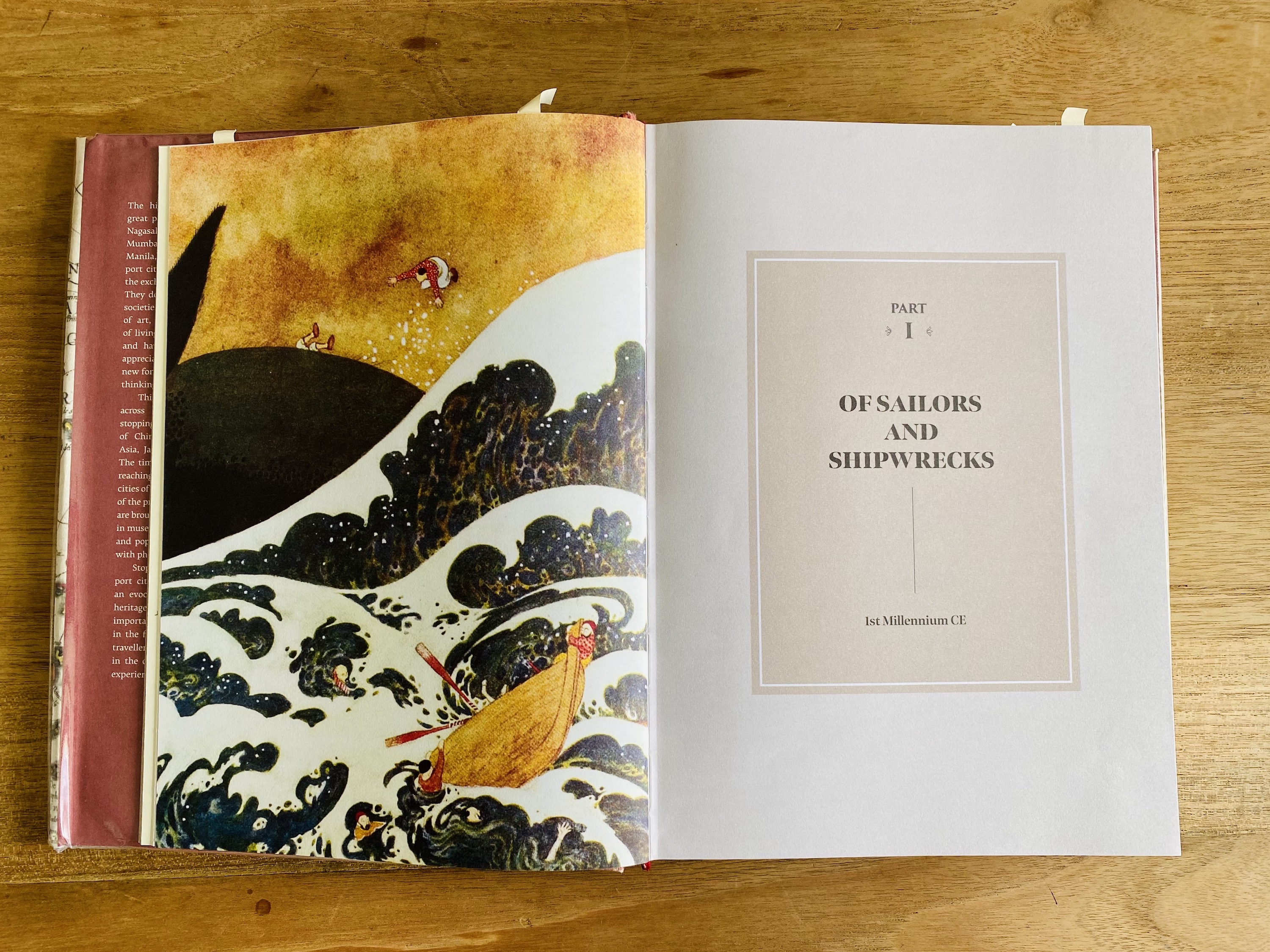
In my book, THE GREAT PORT CITIES OF ASIA: IN HISTORY, each chapter serves as a potted history of one, two, or sometimes three, historic port cities in Asia.
The narrative for each invariably begins with a story… of an object in the museum, a magnificent building, a pivotal moment in time, a species of native plant, or a yummy dish from the local cuisine.
Where possible (but alas, not always), the story is illustrated.

The NAGASAKI chapter (in Part III – Of Spices and Companies), begins thus:
“In the galleries of the Kobe City Museum, there is a spectacular and arresting pair of six-fold byobu depicting an unusual scene: the arrival of the Portuguese in Japan. The byobu is a masterpiece, and was evidently made for a great and wealthy patron. Its surface is meticulously gilded in gold leaf and shimmers under the light. The pomp and circumstance of the Portuguese arriving at port is vividly captured in painting, with the artist, Kanō Naizen (1570 – 1616) – a master of the genre – depicting the Portuguese as curious and exotic strangers. They are seen disembarking from their legendary black ships, dressed in outlandishly-comical costumes that would have put a smile upon the face of the byobu’s beholder. Accompanying the Portuguese are slaves from Africa and the larger Indian Ocean world; deckhands unload all sorts of precious cargo from the south – bales of cloth, spices from Southeast Asia, horses and other exotic animals from India and the Middle East.
The Japanese referred to the Portuguese as namban (南蛮), or “southern barbarians”. These specific types of byobu are referred to as namban byobu and belong to a larger cross-cultural tradition of namban works of decorative art, wherein Japanese traditional craft and artistic techniques were used to depict Portuguese and other Western subjects. Namban was thus akin to a kind of anti-Japonisme, for lack of a better term: the opposite of the West’s later obsession with Japan in the 19th century. First came Japan’s own fascination with and objectifications of the West.
To understand how Japan first came to encounter the West, one needs to tread the boards of the grand kabuki theatre that was trade and geopolitics in East Asia, to explore Japan’s vicissitudes of fortune upon that gilded but uneven stage.”

In the same Part of the book, the MACAU chapter begins thus:
“Galinha à Africana is one of those classic conundrums of Macanese cuisine. Its name means “African chicken”, yet the dish is nowhere to be found in Africa. The origins of the dish are obscure. Some believe it was invented by a local restauranteur in the 1940s; others think it a more recent import from former Portuguese colonies in Africa; yet others say it is a traditional recipe handed down for generations.
There are many variations of galinha à Africana, though locals would tell you it generally consists of grilled pieces of chicken, steeped in a fiery marinade preferably made from bird’s eye chillies, and slathered with a spicy, curry-like sauce. It is then served either with rice in the Asian fashion, or with potatoes in the European fashion; and accompanied with a glass of Portuguese vinho verde. It is a hybrid dish through and through. The form of the dish closely approximates piri-piri chicken, a similarly fiery, classic grilled chicken dish from Mozambique; though the liberal use of coconut milk, curry powder and spices betrays Indo-Malay influence from the port cities of Melaka, Goa and the Malabar Coast. Finally, chillies and potatoes are not indigenous to Europe, Asia or Africa at all. They originate in the Americas and travelled from New to Old World by way of the Columbian Exchange.
Thus, while it is most likely a contemporary invention, the galinha à Africana’s very nature reflects Macau’s age-old identity as a cosmopolitan port city with trade and cultural links to former Portuguese-speaking territories in Africa, Asia and the Americas. This identity is also reflected in Macau’s Chinese name. Aomen (澳門) – read Ou-Mun in Cantonese – means “harbour gate”; and indeed, for centuries, Macau has been a gateway between China and the world.”
The intent of these short story-prologues at the beginning of each chapter is to capture the readers’ imagination, thus drawing them into the narrative in the first instance. The alternative – which is to simply begin with a straightforward retelling of the history of each port city – would not have had the same effect.
The object of the story-prologue thus functions as a magical talisman of sorts. Invoking it opens up a portal to the past, within which the City is gradually revealed in its full splendour, bursting with colour/culture and throbbing with life.
* * *

There is a structure to these story-prologues of mine. One that – I must confess – is practically formulaic. Each of these I’ve structured in three parts as follows, with parts A and B being interchangeable.
A – DESCRIBE THE OBJECT, making sure to highlight visual details that the lay observer would otherwise not notice. Convey a sense of wide-eyed wonder in your description, as though you were a child (or avid collector or architectural enthusiast or consummate foodie), peering closely at the object for the first time.
B – ELABORATE ON THE SIGNIFICANCE, whether historical or cultural, of the visual details you have highlighted, or of the object itself. Keep the elaboration brief and factual. Be sure to adopt an animated but authoritative tone – approximating the air of a cool history professor on a late-night talk-show. Do NOT ramble on.
C – DELIVER THE PUNCHLINE. Answer the question “so what?” Why is this information important to the reader? How is this relevant to the history of this particular port city? Create a bridge to the larger narrative about to unfold.
In addition, THE RULE is that the entire story-prologue must take no more than 3 minutes to read aloud.
* * *
Yes, I confess that I picked up this approach to story-telling while at the museum. This is precisely the way I’d talk about an object on my frequent Director’s Tours through the galleries.
Through repeated practice, I landed on the perfect formula. I had the chance to hone my story-telling to an art, which I could then apply to my book.
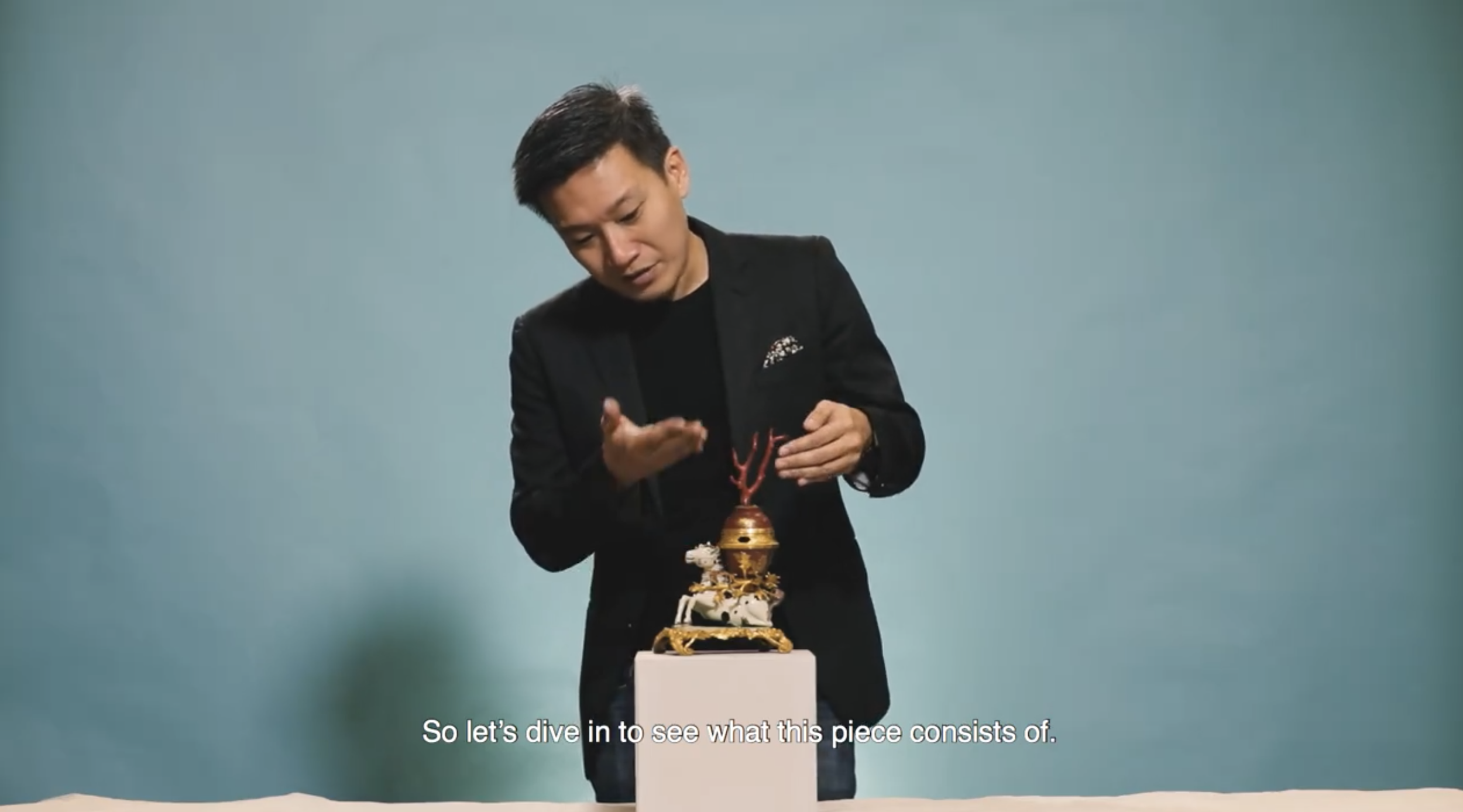
None of my Director’s Tours have ever been recorded in entirety. But thankfully, a few of the object videos the museum recorded of me are still online. Note how my spiel adheres broadly to the structure and 3-minute rule.
Here’s one of the Mounted Incense Burner – my favourite object – which I otherwise refer to as the Crazy Horse:
https://www.facebook.com/watch/?v=1425479120949072
And here’s another – of the Virgin Mary, which also features as a story-prologue in the MANILA Chapter of The Great Port Cities of Asia: In History:

https://www.facebook.com/NationalHeritageBoardSG/videos/1551257164897147/?_rdr
* * *
Story-telling is not just an art, there has to be HEART ❤️ to it. You not only have to adhere to a structure, you also have to imbue your story with multiple degrees of CARE.
An engaging story requires three levels of CARE (in my experience):
- One must first CARE about the object of the story. Good story-telling requires emotions. When you care about what you’re speaking about, your passion and curiosity seep through every word you utter and are conveyed to the audience. You speak more animatedly. The energy you exude is infectious.
- One must then attempt to intuit what one’s readers/audiences CARE about. You must know who you’re speaking to. What makes them tick. What would engage and entertain them. Different types of visitors/readers care about different things. You would tactically shape your spiel and tone according to your audience – eliding or elaborating where necessary; switching between authority or camaraderie with ease. You must be driven not merely to impart knowledge, but more importantly, to surprise and delight.
- One’s story must ultimately answer the question “who CARES?” This is just another way of saying “DELIVER THE PUNCHLINE” (see three-part story-structure above). In other words, there must be a point to the story – why does this all matter? You must be able to link what you’ve said to something that is of relevance to your audience or to the contemporary day. Something has to change within the minds of your audience – perhaps they are now regarding the object, the world they live in, or themselves, from a fresh perspective.
At the risk of being too tongue-in-cheek, the formula for an engaging story; a story with HEART is thus:
ENGAGEMENT (❤️) = STRUCTURE x CARE3, or in short, E = SC3


* * *
In structuring THE GREAT PORT CITIES OF ASIA: IN HISTORY, I was inspired not only by historic travel journals such as the Rihlah (Itinerary) by Ibn Battutah or Marco Polo’s Travels; but also by epic collections of tales, such as 1001 Nights, Chaucer’s Canterbury Tales or Boccaccio’s Decameron.
In each of the latter, there is a larger frame narrative that envelops a collection of much shorter tales. Most often than not, these tales are standalone. Though some might be linked to others thematically or form part of a slightly larger, continuous narrative. Often there are stories nested within stories, like Russian dolls.
In a similar fashion, every chapter of THE GREAT PORT CITIES OF ASIA: IN HISTORY is its own self-contained tale. But each tale itself is made up of a profusion of smaller, nested stories, strung together like a necklace of pearls. And oftentimes, stories in a few different tales contain similar themes or feature recurring characters.
The overall structure of the book is thus complex and fractal. The whole is far more than the sum of its parts.
The GUANGZHOU (CANTON) chapter, for example, consists of the following parts, each of which are stories, in and of themselves, adhering, more or less, to the three-part story-structure articulated above:
- STORY-PROLOGUE: description of the Canton hong 行bowl in the Asian Civilisations Museum’s Trade Galleries;
- Potted history of Canton from the 9th to 17th centuries;
- Qing Emperor Kangxi’s attitudes to trade + The Canton System or “One Port Principle” 一口通商;
- How trade worked in Canton + Introducing the 13 Hong (factories) on the Canton waterfront;
- Development of Pidgin English as lingua franca;
- Trade in tea (Camellia sinensis) from Canton
- STORY-EPILOGUE: Trade in opium as prelude to the Opium War.

* * *
Stories need closure. One has to offer a conclusion, but always in a manner that is non-conclusive, open-ended, leaving the audience or reader wanting more.
The narrative in each chapter of THE GREAT PORT CITIES OF ASIA: IN HISTORY closes with a story-epilogue that doubles up as a cliff-hanger, suggesting that the ending is, in fact, only the beginning. That there is more to come, in the pages that follow.
Sometimes the story-epilogue is a narrative cliff-hanger, prefiguring some sort of “Part II” or “final conclusion” appearing in a future chapter or section of the book.
Sometimes the story-epilogue is an emotive cliff-hanger, in the sense that it excites the reader and piques their senses, but ultimately leaves them unfulfilled

The story-epilogue for the COLOMBO chapter (in Part V – Of Steamships and Modernity) hopefully serves as an emotive cliff-hanger. It leaves the reader salivating and eager to visit the city, if only to have a taste of the dish described.
“Emerging from the museum after a full day of time-travel, the history buff would be well-placed to stop in at one of Colombo’s most under-visited yet most intriguing historic sites: the tiny Dutch Burgher Union building, dating to 1913 and located at the southwestern edge of Cinnamon Gardens. Here, one may learn more about the history of the Dutch Burghers, or Dutch Eurasians – one in a rich diversity of creole cultures in Asia; cousins to the Macanese, the Goans and the Kristang. The Burghers have been here for a long time, at least since the 17th century; and they have retained a surprisingly strong sense of identity, particularly in relation to their unique material culture and cuisine.
The highlight of a visit to the DBU (as it’s affectionately called) is a meal of authentic lamprais at its modest little café. Lamprais is a quintessentially Sri Lankan dish with Dutch, Malay and Ceylonese influences. The name is the English approximation of the Dutch lomprijst, which literally means “a lump of rice”. Don’t be fooled by the humble appearance of this most complex dish: comprising rice accompanied by side dishes including a meat curry, an eggplant moju (spicy and tart pickle), frikkadels (deep-fried Dutch-style minced-beef meatballs), pol sambola (spicy grated coconut) and more, all wrapped up and baked in a banana leaf. Every morsel of it is steeped in the history of the Indian Ocean, and Colombo’s central role as a crossroads of cultures and civilisations.”

In comparison, the concluding paragraphs for the SEMARANG & SURABAYA Chapter (in the same Part) serve as narrative cliff-hanger, prefiguring Part VI of the book, which spotlights post-colonial history.
“One of the most iconic photographs of the Battle of Surabaya features the burnt-out husk of a once-glamourous LaSalle 1940 Series 52 sedan, manufactured by General Motors. The car had belonged to one Brigadier Aubertin W. S. Mallaby, commander of the British troops on the ground. Approaching the epicentre of the conflict at Jembatan Merah in his car, Brigadier Mallaby had been shot to death in a gunfire skirmish, and his vehicle blown up by a grenade. To the left of the smouldering vehicle, standing tall in the distance, is the familiar bullet-shaped dome and tower of Surabaya’s Cigar Building. To the right of the vehicle, and just behind it, is a large placard with the image of the Indonesian flag and these immortal words: “Once and Forever – The Indonesian Republic”.
Merdeka! one almost hears the rallying cry. Merdeka! Merdeka!
The British would win the Battle of Surabaya, just barely; and the struggle for independence would take another four long years. But time and history were on Sukarno’s side. The Dutch finally relinquished Indonesia in 1949 and the Republic would come into being on 17 August 1950, exactly five years after Sukarno’s Proclamation. Indonesia’s Independence Day would be set on 17 August, while 10November was declared Hari Pahlawan, or National Heroes’ Day, in commemoration of all who died in the Battle of Surabaya.
Between 1945 and 1965, almost all former colonies in Asia and around the Indian Ocean gained their independence. Some would manage to accomplish this transition peacefully; most would find themselves lapsing into the violent throes of civil war en route to nationhood. By the 1970s, only a few territories remained in the hands of the imperial powers, and a new dawn broke over the East.”
And then in rare instances, the story-epilogue willfully propels the reader backward rather than forward in the narrative, referencing small story details in earlier Parts of the book, thus revealing that the narrative as a whole – as least for this book – is not a traditional, linear one, per se, but rather, a glittering, labyrinthine construct that I – the diabolical author-storyteller – have painstakingly built in order that you, the reader, will be so enraptured you lose all desire whatsoever to leave my story-world.
That – to keep you endlessly and fatally enthralled – is the ultimate intent of storytelling.
Enjoy the read!



 Dream Of A City